Sydney Disability Support
Designing Digital Systems for Care-Driven Organisations



Challenge
Sydney Disability Support operates in an environment that is fundamentally more complex than a typical service business. Their work involves coordinating across NDIS participants, families and carers, support staff, and volunteers simultaneously, all while maintaining accurate records, meeting compliance requirements, and communicating with sensitivity. As the community grew, the limitations of their existing setup became harder to ignore. Information was scattered across messages, spreadsheets, and informal tools, which made coordination slower and increased the risk of updates being missed or acted on too late. Designing for this environment also came with an additional layer of responsibility. Any digital platform needed to work for people with varying abilities, families accessing information on behalf of others, and staff using the system under busy, real-world conditions. That meant simple navigation, predictable interactions, clear visual cues, and reliable mobile access were not optional considerations but core requirements. At an operational level, the lack of a unified system also meant the team had limited visibility into service requests, staff activity, participant history, and workload distribution, which made planning and coordination increasingly difficult as the organisation expanded.
Solution
Rather than attempting a large overhaul in one step, Cuebites worked with Sydney Disability Support incrementally across multiple phases, solving immediate problems while building toward a fully connected digital environment. The strategy was to deliver value at each stage rather than asking the organisation to wait for a complete system before seeing any benefit. This meant starting with the participant and family experience, then building out internal operations tools, and eventually supporting community engagement through social content. Each phase was designed with the others in mind so that everything connected into a single ecosystem over time.
Implementation
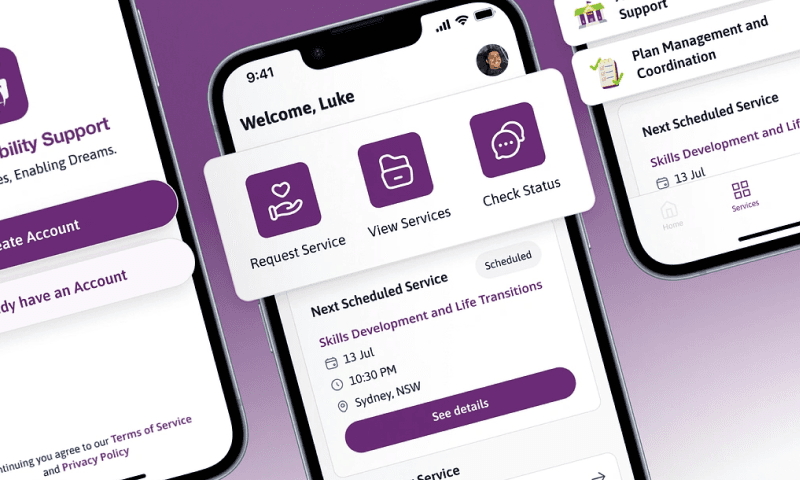
The first phase focused on the public-facing experience. An accessible website was built to communicate service information clearly and provide a supportive entry point for participants and families. A companion mobile app gave participants and families access to updates and resources in a format that prioritised ease of use, readability, and comfort, particularly for users accessing support during stressful moments. The second phase shifted focus to internal operations. A custom admin portal and CRM were built around SDS workflows, giving staff role-based access, a central dashboard showing live service activity, service request handling with status tracking, detailed participant profiles with full history, real-time notifications and reminders, and custom reporting with CSV and PDF exports. This replaced the fragmented mix of tools the team had been relying on with a single source of truth. With the systems connected, the third phase brought participant records, staff assignments, and volunteer involvement all into one place, allowing the team to coordinate across the full community without increasing administrative effort. The fourth phase supported SDS's external presence through social media post design, community-focused messaging, user-generated content, and short-form video, maintaining a consistent and empathetic presence across digital channels.
Optimization
The connected system reduced administrative effort significantly by centralising workflows that had previously been spread across multiple tools. Response times improved through live alerts and reminders that kept staff across service activity without manual checking. Participant records and reporting became more accurate, and the team gained the operational visibility needed to plan effectively and make better-informed decisions. On the community side, consistent social media output helped build trust and maintain engagement across participants, families, and the wider community. The result was not a collection of standalone features but a digital environment that actively supports the way care delivery works in practice.
Case studies